
HMSOM, Stevens Partnership Bioengineering the Future Through Students
March 10, 2026
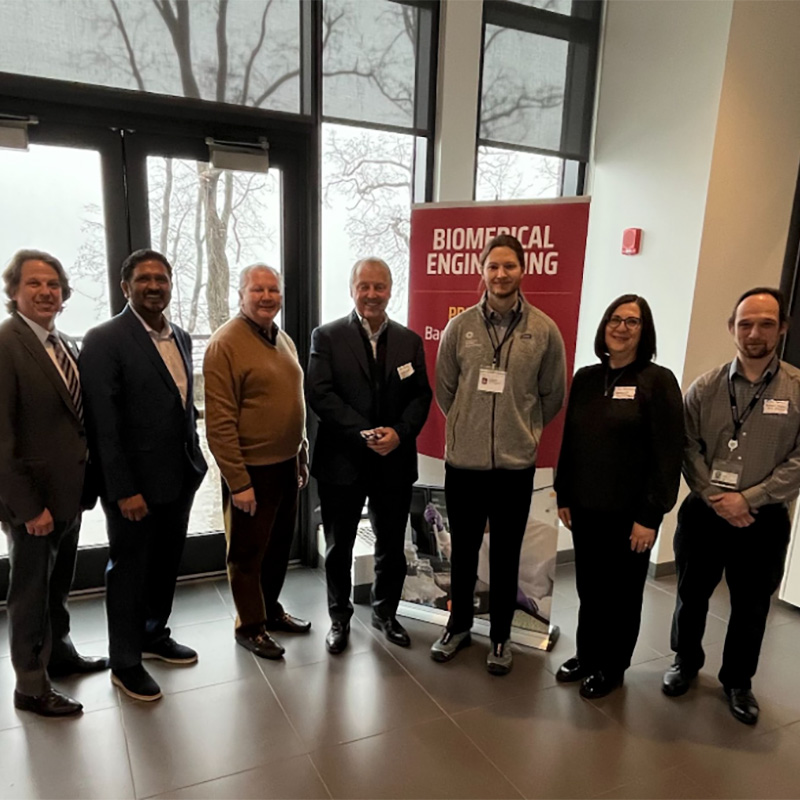
Garrison Allen, third-year Hackensack Meridian School of Medicine student, recently shared his academic journey: from chemical engineering as an undergraduate, to U.S. Food and Drug Administration research in a postbaccalaureate fellowship, to medical school - and now a unique combination of all that know-how to innovate for the future.
Fittingly, the Feb. 20 presentation was given at Biomedical Engineering Day at the Stevens Institute of Technology, where Allen is pursuing the HMSOM-Stevens Biomedical Engineering Master’s degree through the joint partnership of the institutions while he pursues the medical degree.
“I want to pursue a medical degree, and treat patients with the standard of care - but I also want to drive the innovation in imaging forward, to improve that standard of care,” said Allen recently. “I wanted to increase awareness among students and faculty about the partnership to help foster more collaboration going forward.”
Allen’s experience is part of a groundbreaking collaboration between the two New Jersey institutions. A memorandum of understanding signed in October 2024 between Stevens and HMH, accelerated the collaboration between the students and faculty at both institutions.
“We greatly value our partnership with Stevens, and what it can produce for the future,” said Stanley R. Terlecky, Ph.D., vice dean of research and medical sciences at the Hackensack Meridian School of Medicine.
A kick-off meeting in February 2025 jump-started the inspiration between the two institutions. More than 60 participants - HMH physicians, scientists and nurses joined Stevens faculty to discuss working together in four specific areas: chronic-care delivery; medical imaging; bioinformatics and rehabilitation engineering; and medical robotics.
In Summer 2025, the first HMH medical students, like Allen, began to earn a master’s degree at Stevens in biomedical engineering.
Allen’s presentation went over what it’s like to pursue both interests, and both degrees, and how it is a catalyst for careers.
The M.S. in biomedical engineering program is design-oriented to help students pursue new technologies from concept through commercialization, according to Stevens. Eight concentrations in key areas are available to students: Medical Devices, Biomaterials and Regenerative Medicine (Thesis and -Non); Rehabilitation and Biomechanics Concentration (Thesis and -Non); Medical Imaging and Artificial Intelligence Concentration (Thesis and -Non); and General Concentration, (Thesis and -Non).
HMH leadership continues to express optimism about the collaboration.
“Ultimately, this continued partnership will lead to scientific advancements translating into better outcomes for our patients,” said Ihor Sawczuk, M.D., HMH’s president of Academics, Research, and Innovation, in 2025.