
Key Takeaways
- Hackensack Meridian School of Medicine students begin working with families in the community from their first day of medical school through the Human Dimension program.
- Students learn how family life, transportation, technology, access to care and other social factors can affect a person's health.
- Students build long-term relationships with assigned families and may help them find resources, prepare for appointments and navigate everyday health needs.
- The Human Dimension program currently works with 778 families and more than 150 community partners.
- HMSOM has shared its approach to community-based medical education with medical educators in the U.S. and internationally.
AI generated.
In a traditional model of training doctors at medical schools, students don’t meet patients until they encounter one in a sterile exam room.
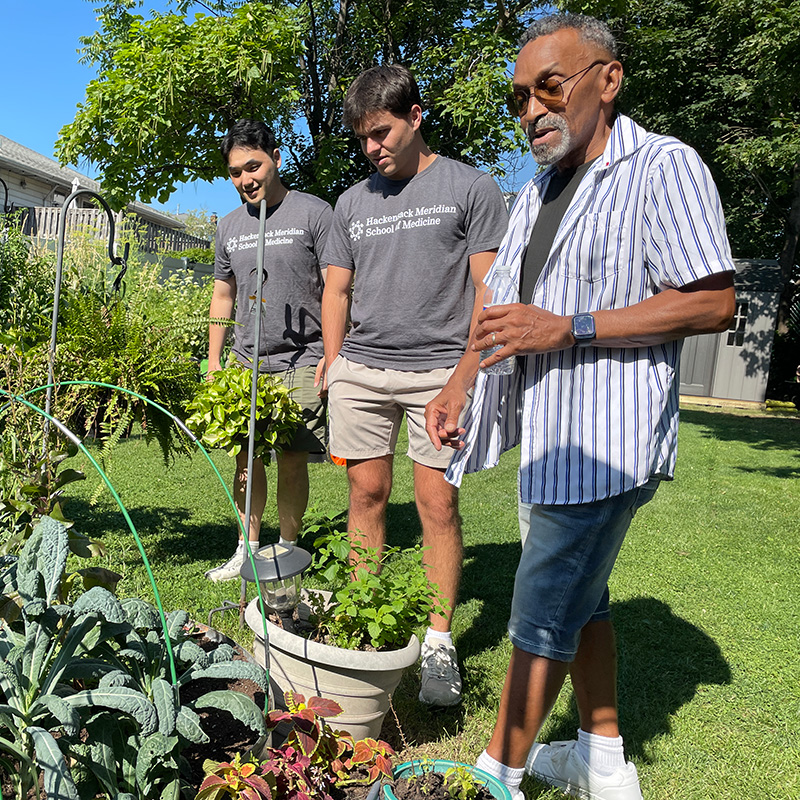
At the Hackensack Meridian School of Medicine, some of the best learning can be found in the lush backyard garden of Rafael Herrera, right at the meeting of root and soil.
Herrera, a septuagenarian veteran with some health issues, welcomes Dongsu Kim and Michael Menes at his home every month. Herrera is a participant (VP) in the medical school’s centerpiece “Human Dimension,” or HD, program.
Herrera is a spark plug, despite a decades-old spine injury from his time in the Army. A “professional grandfather,” he cooks and educates his family - and also the two medical students who visit monthly. Herrera tells them about the 14 pills he takes a day for various conditions, including bipolar disorder, along with a lot of conversation about the context of his life, from past to present and onward to the hopes of the future. Together they inspect the teeming backyard where Herrera harvests many of the ingredients for use in the kitchen for supper. The students take careful notes - and while they listen and learn, they often come back with “check-ups” on Herrera’s appointments, and how he is doing.
“Even though I have a whole bunch of resources, including the VA, it’s great to have them as additional support,” said Herrera. “I want them to see me as everything I am - not just my medical side.
“This is beyond bed manners,” the VP added.
‘Beyond bed manners’
In HD, the doctors-to-be like Kim and Menes start off from “Day One” reaching out into the community. It’s a centerpiece of this relatively new medical school, which first admitted students in 2018 and has now graduated more than 500 world-class physicians.
Second-year medical students Kim and Menes have been visiting with, and learning from, Herrera since they started at HMSOM. The big change they’ve effected for Herrera: they have empowered him to use the VA app proficiently, to schedule rides since he cannot drive, and he has been able to find rides to easily make his all-important appointments with the agency. Herrera is also an avid user of AI, and they have helped with computer safety based on the technology’s current benefits - and limitations. Additionally, they have investigated recipes that Herrera can whip up in his kitchen, using ingredients from that lush garden outside his window.
Menes said the VP has been an education in and of himself.
“It’s been eye-opening to see his perspective on things - to see how he lives with his daughter and grandson,” said the student. “We can understand better how it’s not just a patient who is in a clinical setting - there’s a whole family behind them.
“After all, medicine is a humanitarian vocation,” added Menes.
Dongsu and Michael thus learn about the “social determinants of health” first-hand that they couldn’t learn from a textbook. And together, they solidified a working relationship through spending time in the home, and learning to see what Rafael sees, what he hears, and smell the food he cooks using ingredients from his garden.
A model for other med schools
The Human Dimension is a New Jersey success story, but it is also a blueprint for healthcare’s future. The program currently reaches 778 families and partners with over 150 community partners. Its focus on long-term relationships and social determinants is so effective that it has become a model for community outreach initiatives at other institutions nationwide and beyond. Recently Human Dimension leaders have showcased what the school does at the American Association of Medical Colleges (AAMC); leaders have published in many national journals; they presented and taught HMSOM’s unique expertise about best practices in community-engaged “med ed” at the international AMEE (The International Association For Health Professions Education) conference in Vienna in August; and the school is leading the charge nationally among other top-notch medical schools.
At HMSOM, students like Kim and Menes follow their assigned families from the very first day of their education. By the time they become doctors, they thus see patients not just as diagnoses, but as people with stories that grow - and blossom - over time.