
Key Takeaways
- Hackensack Meridian School of Medicine faculty shared medical education research and teaching methods at the AMEE 2026 conference in Vienna, Austria.
- HMSOM presented its approach to metacognitive learning, which helps medical students identify knowledge gaps, evaluate how they learn and adjust their learning strategies.
- Faculty shared HMSOM’s community-engaged medical education model, which connects medical students with people and community organizations over multiple years.
- Other presentations explored feedback in medical education, the Human Dimension program and its expansion into graduate medical education.
- HMSOM faculty also contributed to research on integrating climate health and environmental health topics into medical school education.
AI generated.
The medical education learning process, community outreach, environmental awareness and other leading-edge topics were the focus of Hackensack Meridian School of Medicine (HMSOM) workshops and research presentations at the annual conference of AMEE (The International Association for Health Professions Education) in Vienna, Austria, in August.
The gathering drew thousands of medical educators from across the globe, providing an international platform for HMSOM to showcase its pioneering work in metacognitive learning and community-engaged medical education, among other topics.
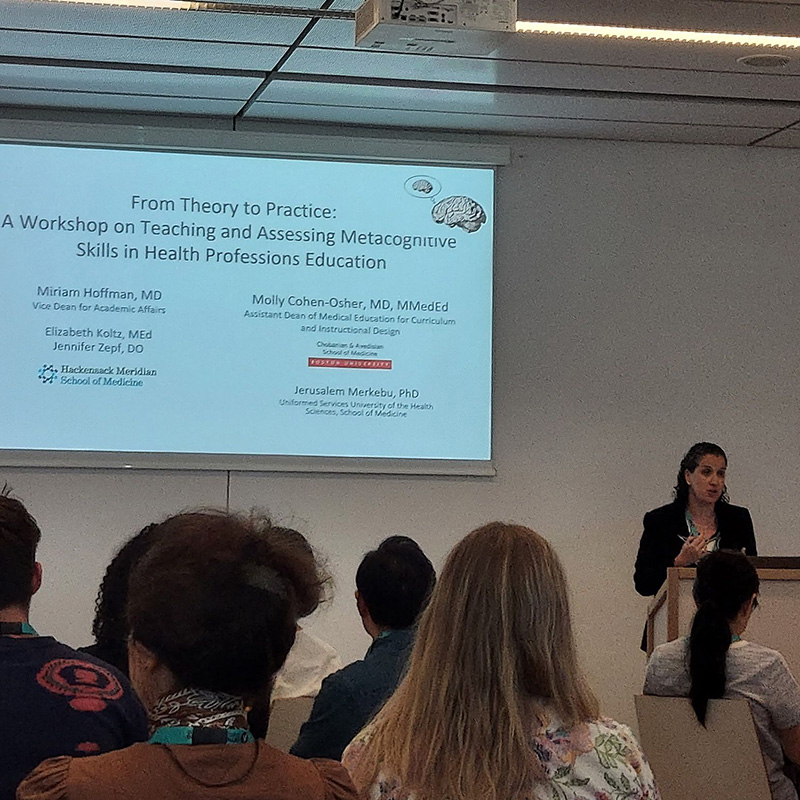
Among the conference highlights: a standing-room-only workshop titled "From Theory to Practice: A Workshop on Teaching and Assessing Metacognitive Skills in Health Professions Education". Led by Miriam Hoffman, M.D., vice dean for Academic Affairs at HMSOM, alongside Molly Cohen-Osher, M.D., MMedEd, of the Boston University Chobanian & Avedisian School of Medicine, and collaborators Elizabeth Koltz, M.Ed., Jennifer Zepf, DO, and Jerusalem Merkebu, Ph.D., the session generated immense interest, drawing an overflowing crowd of international participants.
The workshop grounded metacognitive theory—learners monitoring, evaluating, and consciously and consistently adapting their own cognitive processes—into practical academic design and support. HMSOM has embedded such a skills curriculum since its earliest days, equipping medical students to identify knowledge gaps, utilize evidence-based learning strategies, and develop adaptive expertise, said Hoffman.
“People are recognizing more and more that this is a skill set and a competency that you need to be an effective healthcare professional because the body of knowledge is changing, the required skills are changing, and if you don’t have well-developed metacognitive skills, you’re not going to be able to be an effective healthcare practitioner,” said Hoffman. “I think that really resonated with people.”
"Expanding Your Community-Engaged Medical Education (CEME): Bridging from Principles to Practice," was another Hoffman workshop presentation, representing co-author Carmela Rocchetti, M.D., assistant dean of CEME, and members of the school’s Human Dimension team.
The workshop introduced international colleagues to the school’s core CEME framework, pairing medical students with people and organizations out in the community over multiple years to directly address the social determinants of health. The session generated immediate global interest, including outreach from medical education leaders in South America and Europe interested in adapting HMSOM's systematic CEME structure.
Other presentations represented groundbreaking programs at HMSOM.
Marygrace Zetkulic, M.D., vice chair for Medical Education and associate professor of Medicine at HMSOM, co-led an interactive workshop titled "Working with 'Insightopenia': Reframing and Updating Feedback," examining how educators can ensure they are cultivating learning awareness, emotional intelligence, and feedback literacy using modern frameworks soliciting feedback.
The expansion of the Human Dimension program into graduate medical education (GME) across the Hackensack Meridian Health network was the focus of a presentation led by Andy Reyes, M.D.
Environmental Health was another major subject. HMSOM faculty contributed as co-authors on collaborative research examining environmental health integration within medical school curricula. The title was "The Climate Health Curriculum Tool (CHCT): A Novel Framework for Integrating Sustainability and Climate Health Resilience into Medical Education", based on the new climate health tool the team designed and published recently in the journal BMC Medical Education. The lead author of that paper is Lawrence Rosen, M.D., FAAP, the assistant director of the Human Dimension.
“The need to develop a climate ready workforce is a key incentive for the development of the tool, so we can prepare our students to be health care system leaders facing climate health threats in the communities and health care systems they'll live and work in,” said Rosen.
HMSOM's strong presence at AMEE 2026 underscored the institution's position at the vanguard of modern “med ed.”
"Engaging with colleagues from around the world reinforces that while our educational settings differ, we share common goals and challenges," Dr. Hoffman reflected. "It is energizing to see HMSOM’s foundational principles helping to inform and shape medical education on a global scale.”